
Tools, Not Magic: Resetting Expectations in Modern Litigation Support
-
 Published on Feb 26, 2026
Software tools in litigation have never been more powerful. Compared to where the industry stood 25 years ago, when platforms like Concordance represented the height of sophistication, the progress has been substantial. Today, a single professional, supported by modern technology, can accomplish work that once required entire teams.
At the same time, expectations have shifted just as dramatically. What we expect from technology, and what we expect from the people using it, has changed. Yet despite the advances, we have not reached an era of “easy buttons” or fully automated outcomes. Litigation remains complex, nuanced, and highly situational.
And that reality is often at odds with how technology is marketed.
Across the legal technology landscape, it’s common to see promises like “save time,” “automate everything,” or “no need for experts.” These messages suggest that a single tool, paired with minimal expertise, can handle virtually any challenge. The implication is that outcomes are inevitable: press a button, and the work is done.
Anyone who has operated inside a real litigation environment knows that this is not how it works.
When matters follow what software teams often call the “happy path,” a single product with an average-skilled user may be sufficient. But litigation rarely follows a happy path. In practice, it is a series of exceptions, complications, and judgment calls rather than a standardized process.
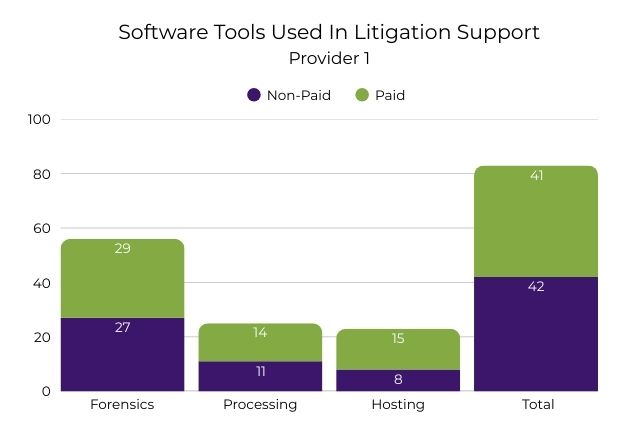
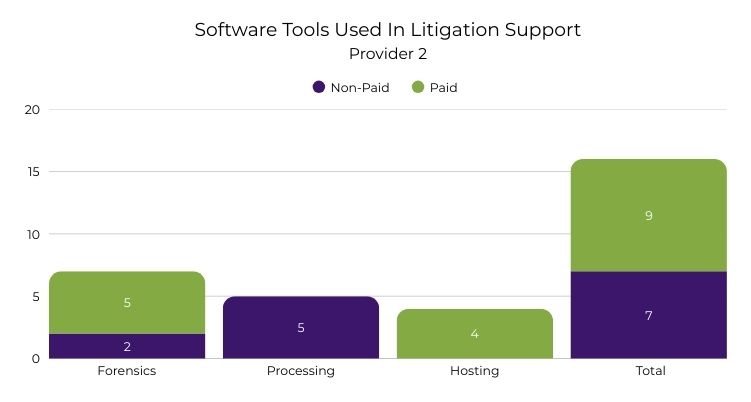
Modern litigation requires an ecosystem of tools: commercial platforms, specialized utilities, freeware, and custom-built solutions working together to address gaps. No single product is designed or capable of doing everything well.
Understanding how to operate even one piece of software effectively requires experience across several dimensions:
- Capabilities: Every product has functions it excels at, functions it does not support, and a third category often overlooked – features it technically offers but performs poorly enough to avoid. Knowing the difference matters.
- Security: Access controls, data handling requirements, and compliance obligations vary widely by client and matter. Security decisions often dictate workflows, team structure, and even tool selection.
- Scale: Scaling software is rarely straightforward. Adding users, increasing processing power, or expanding storage all come with costs and architectural implications that require careful evaluation.
- Training: Tools evolve constantly. Effective use requires ongoing education, updated documentation, and validation of new features before deployment in live matters.
The complexity increases significantly when multiple products are stacked together, which is now the norm rather than the exception.
As toolsets expand:
- Expertise becomes distributed. It is realistic for a professional to be deeply fluent in one or two platforms. Three is possible. Beyond that, true mastery becomes rare.
- Scaling decisions become interconnected. Improving throughput in one area often creates bottlenecks elsewhere, requiring careful coordination across the workflow.
- Security models collide. Competing access controls and permissions can make it challenging to design consistent teams and processes.
- Workflow changes carry ripple effects. A slight adjustment upstream can have unintended downstream consequences that are not immediately obvious.
These challenges are not linear. Managing one tool is simple. Managing two is harder. Managing three or more increases complexity exponentially. Like juggling, each additional element changes the entire dynamic.
Over the past 25 years, the industry has seen remarkable growth in software capabilities. At the same time, we have seen an increase in the number of tools required, the volume of data involved, and the sophistication of both legal teams and the judiciary. The work has become more powerful and more complex.
One thing, however, has not changed: the service provider’s role.
At Innovative Driven, we invest in people as much as we do in technology. We build product experts, educate and support our clients, make informed recommendations, and develop custom solutions where off-the-shelf tools fall short. We take accountability for outcomes (e.g., deadlines, quality, and defensibility) while remaining flexible enough to meet each client’s specific needs.
Perhaps most importantly, we help clients avoid problems before they arise. Experience matters in litigation. Our role is to ensure that your first time facing a challenge does not feel like your first time, because you are not facing it alone.
Technology is essential. But it is not magic. The real value lies in knowing when, how, and why to use the tools available. And in having trusted partners who take responsibility for the results.